Participa en estos cursos para Alemania en octubre con becas Erasmus+ para gestores de proyectos educativos y culturales con las becas Erasmus+ con todos los gastos pagados.
Tienes más becas Erasmus en Alemania a tu disposición en nuestra web.
Fechas y lugar de becas para Alemania
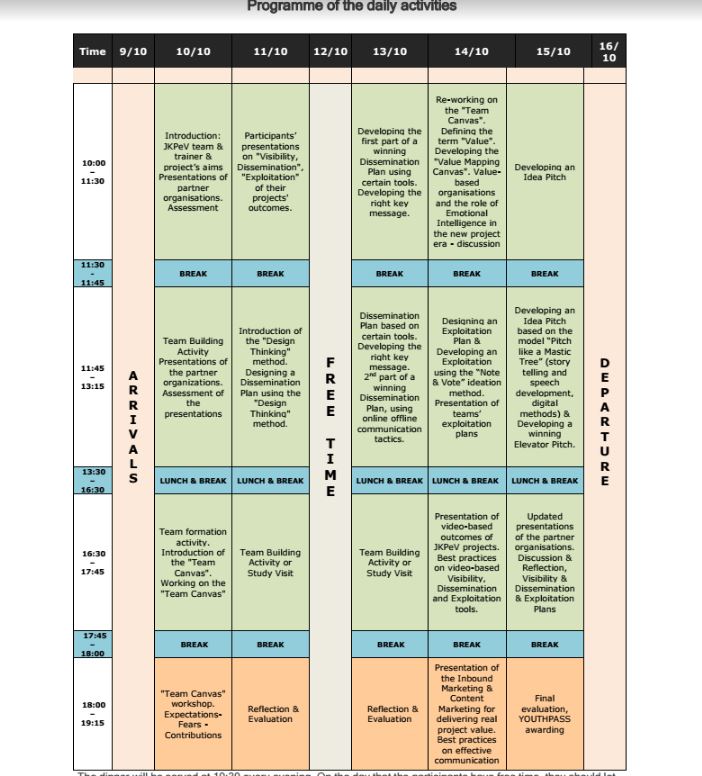
This exploration is going to be materialized through a series of workshops, which is going to be held in Dresden from 9 to 16 October, 2017.
Resúmen del proyecto
Disseminating the results of youth work and the Erasmus+ projects and proving that there is need to implement such youth and community projects as it is beneficial for the society, the young people and other stakeholders, is equally important for all actors. The importance of effective visibility and dissemination and exploitation of project results is highlighted also in the Erasmus+/Youth in Action programme, where having a good DEOR (Dissemination & Exploitation of results) plan and activities is fundamental to have a multiplier effect on the target groups you have set and ensure the sustainability of your project.
Disseminating and exploiting the results of your projects in a meaningful way is important not only for the funders, but also for your target groups and the local environment to join your activities, support your aims, learn from examples and appreciate the work of your organisation. The most essential project results are the learning outcomes that you share among the participants, the participating organisations and the local communities of the participating organisations. Identifying, documenting and communicating these results can sometimes be a challenging task – but it is possible with a strategic plan and a pinch of creativity.
Increasing the visibility of the Erasmus+ youth projects and their impact contributes to the recognition of non-formal learning in international youth work and allows your work to be seen and appreciated by the people and groups most important for you.
The objective is to explore the concepts and benefits of working on the visibility & dissemination of European youth and community projects by means of a well elaborated communication strategy and to build a strong international network of youth organisations that work with Erasmus+ projects.
Objetivos
This training course, which is going to be delivered through a series of workshops and study visits, aims at:
Understanding the importance of developing clear and well-established dissemination and exploitation plans
Appreciating the importance of creating value-driven organizations and implementing value-driven projects with multiplier effect to the community
Learning effectively the use of certain advanced sophisticated processes, tools and best practices so as to develop winning dissemination and exploitation plans that improve the quality of the projects’ impact
During the TC, participants will develop the following skills:
Communication
Presentation
Planning
Creativity
Networking
Emotional Intelligence
Cognitive flexibility
Service orientation
After the TC, the participants will be able to:
Identify and use the fundamental features of an effective project communication strategy
Develop projects’ visibility & dissemination plans, as well as exploitation plans, according to the stakeholders’ requirements
Share best practices and successful examples of visibility, dissemination and exploitation of their projects effectively with their peers, their organizations and the community
Communicate the importance of visibility and dissemination in international youth and community work
Develop effective international horizontal partnerships throughout Europe
Temas del curso
The topics that will be explored during the series of workshops are the following:
Presenting effectively. Assessment of presentation skills based on certain evaluation techniques.
The importance of horizontal teams in developing an effective project communication strategy.
The “Team Canvas.”
The role of the Design Thinking Method in developing winning Dissemination and Exploitation Plans.
Ideation Methods for creating effective Dissemination and Exploitation Plans.
The Key Parts of a Winning Dissemination Plan. The “Dissemination Plan Canvas”. Designing and Developing a winning Dissemination Plan using advanced business and communication tools.
Online and offline communication tactics.
Inbound Marketing and Content Marketing and their role for establishing “Value-Driven” Organizations.
Designing and Developing an Effective Exploitation Plan based on the
“Exploitation Plan Canvas” and by using the «Note and Vote» ideation method.
Developing an Idea Pitch based on the model «Pitch like a Mastic Tree»
Developing a winning Elevator Pitch.
Self-evaluation methods for assessing presentation skills.
Development of an effective digital presentation.
Metodología cursos en Alemania con becas
The training course will be implemented in the form of a series of workshops. Learning by doing, interactivity, non-formal and intercultural learning, co-operative learning, peer-to-peer learning and team based activities will be used so as participants to gain all the appropriate knowledge. Theoretical sessions, based on the most advanced scientific knowledge, will be also integrated, but performed in an interactive way.
Técnicas y herramientas:
Icebreaker Activities- Games
Team-building Activities and Energizers
Team Activities- Assignments
Gamification
Plenary Sessions
Discussion (Bar Camp method etc.)
Presentation
Elevator Pitch
“Canvas” method
Design Thinking method
Ideation methods
Feedback
Self-assessment Tests
Video watching
Relevant reading
Intercultural Evenings
Study-visits
Perfil becarios en Alemania
This training course is aimed at youth workers, trainers, facilitators, NGO practitioners and project managers, over 24 years old, who have:
At least two (2) years of experience in implementing and/or coordinating Erasmus+ projects and running youth and community projects
Worked at least for two (2) years in one of the partner organizations (youth organisations)
Actively participated in the formation of two (2) to three (3) visibility & dissemination plans and of one (1) exploitation plan
Implemented communication/promotional tactics, using online and offline tools and techniques
Participants should be:
Fluent in written and spoken English
Willing to co-operate and work in a team
Open to new knowledge, coming from other disciplines, so as to integrate it to what they already know
Motivated to take part in this training course and to be personally interested in its topics and take this training course seriously
Motivated to disseminate the gained knowledge to their local communities
Motivated to interact with the other participants, to promote their organizations’ best practices and share their ideas for future projects in order to create new international partnerships
Preparación antes del curso:
The participants who are selected should:
Prepare a creative presentation about the organization they represent. The duration of the presentation should not exceed five (5) minutes and it should be in digital form (powerpoint, prezi, etc.)
Prepare a presentation, in any form they want, concerning the methods, tools and best practices their organizations use in order to develop visibility and dissemination plans, as well as, exploitation plans. This presentation should not be longer than three (3) minutes.
Prepare an outline, regarding the content of a project visibility & dissemination plan, as well as, of an exploitation project plan, based on their experience in these fields.
¿Qué traer a Alemania?
All the participants should bring with them:
A Laptop or any other mobile device suitable for working their presentations
The material they are asked to prepare, as described under the title “Preparation of the participants before joining the Training Course” enclosed in this Info Pack.
Many questions on how to develop their communication skills and the communication strategy of their organizations
Their willingness to learn and have fun!
Selección cursos Alemania
Building Bridges takes the issue of participant selection very seriously in order to ensure the quality of the the training course “Spread the Word”. Selecting suitable people to attend our trainings is one of the most important contributors to having a successful project and having maximum impact.
Participants’ selection process consists of two phases:
1st Phase
The applicants should send to Building Bridges their CVs and the attached registration formed filled out.
They should pay special attention to fill in the form carefully and with all the required information and respect the deadline.
We definitely advise you to send at least 1 person from your organisations who is responsible for the visibility of your projects, the dissemination and exploitation of the results of your projects and networking as it will be very beneficial for your organisations. Moreover, it is good to send us 4 to 6 profiles of applicants so that we are able to select the most suitable ones.
The selection process will be held by the leading organization in co-operation with the trainer of the training course and will be completed on 20th of August.
The selected participants will be notified so as the second phase of the selection process to be implemented.
2nd Phase:
The selected participants will receive an email, on the 20th of August 2017, notifying them that they have passed the first phase of the selection process.
This e-mail will include an attached file entitled “Training Needs Assessment Questionnaire” that should be filled out and sent back to us til the 27th of August.
The selected participants will also have to have a Skype meeting with a duration of ten (10) minutes with the trainer of the training course.
These Skype meetings will be held at the end of August. No tricky questions are going to be asked. The only thing needed is honesty!
And, these virtual meetings will be an opportunity for the potential participants to ask anything about the training course. The selected participants will be informed about the time of the Skype meeting via an email which will be sent by the trainer.
After evaluating the filled Training Needs Assessment Questionnaires and based on the feedback received by the Skype meetings, the trainer will contact the participants. From the 1st of September the selected participants can book their tickets according to the Erasmus+ programme rules for travel expenses.
Youthpass
Within the frame of ‘recognition of non-formal learning’, all participants will receive a ‘Youthpass’ Certificate at the end of this training. Youthpass is part of the European Commission’s strategy to foster the recognition of non-formal learning. It is a certificate which supports the reflection upon the personal non-formal learning process and visualises and fosters active European citizenship of young people and youth workers. Moreover, Youthpass is a Europe-wide validation instrument for non-formal learning in the youth field. It contributes to strengthening the social recognition of youth work and makes visible the key competences of participants gained through an Erasmus+ project. Youthpass finally aims at supporting the employability of young people and youth workers.
Costes cubiertos para cursos en Alemania
Subsistence, lodging and programme costs will be provided and paid by a grant from the National Agency of Germany of the “Erasmus+” Programme.
There is a participation fee of 30,-€ for each participant which will be deducted from the travel expenses, apart from the fee of Building Brdiges (40€).
Participants should arrange by themselves their insurance. Please contact your local Health insurance provider to obtain one for free.
According to the new Programme Erasmus+ (2014-2020) there will be a refund of the whole amount of the real travel expenses according to the approved budget for each participating country that you will find below:
Spain 275,00 €
If you decide to stay longer (maximum four days), you should first inform the project coordinator and you should also take into consideration that you are responsible to cover your own living expenses for the extra days of your stay in Germany. All participants will be reimbursed only after submitting all receipts, invoices and original tickets and boarding passes and after filling out the mobility tool e-report and the final evaluation form.
Please make to provide to the organisers the following:
The original invoice/receipt of the flight ticket or the train/bus ticket (with clear mark how much you have paid).and the boarding cards and/or tickets.
The invoice should be addressed to yourself, or your organisation.
If you receive an electronic ticket, please print out a copy also for us and send both the invoice and the ticket via email
You should be aware that if the total amount of your travel expenses exceeds the travel expenses budget limit (Erasmus+ programme travel expenses’ reimbursement rules) as indicated in the chart above, then the additional amount of your travel expenses shall be paid by you.
When you arrive in Dresden you are expected to submit all original boarding passes and tickets to the project coordinator (without original boarding pass, we will not be able to reimburse the participants). After we receive all boarding passes, receipts/invoices and tickets, and after you fill out the e-form of the mobility tool (e-report) which is going to be sent to your email address, then approximately one month later, the total amount of your travel expenses will be transferred to their bank accounts.
For this reason, please send us via email your bank account details after sending your tickets:
– name of the bank account holder
– name of the bank
– BIC/SWIFT code
– IBAN number
When you depart from Dresden and you travel back to your home city, please save all the original train and bus tickets or any other tickets of your return and send them via post
Viaje
On Monday the 9th of October, 2017 all participants are expected to arrive at Mezcalero Guesthouse by 19.00. Dinner will be served on this day at 19:30 and the team will be at Mezcalaero’s reception at 19.00. On Monday the 16th of October, is the departure day and check-out time is at 12:00 p.m.
By plane: All participants should book their flights on their own in advance according to the travel expenses budget of the project. Participants are advised to book their flight to Berlin Schoenefeld or Tegel airport as Berlin is only 2 hours ride by bus from Dresden.
From Berlin airport to Bahnhof Neustadt Dresden (Neustadt Train Station) by bus: After booking the flight, participants should book their bus ticket online. There are two airports in Berlin: Berlin Tegel and Berlin Schoenefeld.
From Tegel airport to Dresden: There is only one bus company driving from Tegel airport to Bahnhof Neustadt Dresden:
https://meinfernbus.de/. You are advised to book your bus ticket online in advance as it is cheaper and many times it is fully booked. The bus stop in Tegel airport is close to Terminal D and you can see a green sign “MeinFernBus”. When the bus arrives in Dresden it makes two stops: the first one is called Bahnhof Neustadt (Neustadt Train Station) on Hansastrasse and the second bus stop is called Hauptbanhof (Main Train Station) on Bayrische Strasse. You need to get off at the first stop:
Bahnhof Neustadt.
From Berlin Schoenefeld airport to Dresden: You can take Meinfernbus
http://meinfernbus.de but please book it online in advance as it is cheaper and most of the times it is fully booked. It makes two stops: the first one is called Bahnhof Neustadt on Hansastrasse and the second bus stop is called Hauptbanhof (Main Train Station) on Bayrische Strasse. You need to get off on the first stop: Bahnhof Neustadt. The bus stop in Schoenefeld airport is exactly outside the airport on the parking space of buses on the right close to Terminal B. There is also another bus company which is quite cheap and is Czech:
However, this bus company doesn’t have so many frequent routes like Meinfernbus.
It is recommended to book your bus tickets online in advance!
Mezcalero Guesthouse
All participants will stay in four-bed-rooms at Mezcalero Guesthouse. Please make sure that you are able to stay with other people in a four-bed-room, otherwise there is additional cost for those who wish to stay in double or single rooms and we need to know in advance. The participant then is expected to pay the difference. For 4 -6 persons there is a bathroom with toilet. Mezcalero is a hostel, a guesthouse and a hotel – all in one. It fills in the gaps of each category and, thus, uniquely complements the offer of accommodations in Dresden. It is a family business and it is run following the example set by English Guesthouses and set great value upon individual service.
For example, breakfast buffet is from 7 a.m. to 12 p.m., the reception is open 24/7, and the hostel staff helps the guests with their itinerary planning. In this way Mezcalero combines the friendly and familiar atmosphere of a pension with the service of a hotel guided by the prices of a hostel. The beautiful Aztec ornaments and images make whole building unique and complement Mexican coziness with old Indian culture.
Services
24 hours/day reception
Check-out until 12 p.m.
Breakfast Buffet from 7 a.m. to 12 p.m.
The Mexican bar is open 24/7
Free Wi-Fi in both house
Free Internet terminal
Free luggage storage
Free sanitary articles
Free city maps
Room Service every second day, by request daily
Hair-dryer, alarm clock, iron and board games to borrow
Arriving at the train station Neustadt in Dresden – Bahnhof Neustadt
From the Bus stop on Hansastraße you go up for about 400 m, and on the first road called Lößnitzstraße, you turn right and walk up to first the traffic light you see.
Cross the street, turn left on Königsbrücker Straße and follow it to no.64 on the right side.
After 300 m (980 ft) you will find the Mezcalero Guesthouse next to REWE market.
From Dresden airport to Bahnhof Neustadt
If you take a flight to Dresden, then you can take from the airport of Dresden the S-
Bahn train S2 direction Pirna Bahnhof and you need to stop after about 13 minutes at Bahnhof Neustadt – Neustadt Train Station.
From Hauptbahnhof Dresden (Central Railway Station) to Bahnhof Neustadt From the Central Railway Station of Dresden you can take Tram No3 direction Wilder Mann and you stop at Bahnhof Neustadt.
Alternatively, you can take the S-Bahn No1 direction Meißen S-Bf. Triebischtal and stop at Bahnhof Neustadt. One single ticket (normal price) costs 2,30 € and lasts for 1 hour.
For more information about how to arrive at Bahnhof Neustadt or to use public transport please visit the following website:
https://www.dvb.de/Alojamiento de los cursos para Alemania
The training course “Spread the Word” is going to be held in one of the seminar rooms of the High School “Semper Schule”, about 10 to 15 minutes on foot from the Mezcalero Guesthouse. It is located on Antonstrasse 19-21 right opposite the Train Station Neustadt (Bahnhof Neustadt). The room where the training course takes place is 200 sq metres and is on the top floor. There is an elevator and the room has got all necessary equipment for the training course.
From Mezcalero Guesthouse to the Training Venue “Semper Schule”
From Mezcalero Guesthouse you turn on your left and go down the Königsbrücke Straße (street). You go down this street for about 800m up to the traffic lights at the intersection of Königsbrücke Straße and Antonstraße. At this point, you cross Königsbrücke street and you turn on your right, to Antonstraße. You follow this street and after about 350 m you cross this street. Semper Schule is opposite Bahnhof Neustadt – Neustadt Train Station.
Proceso selección para las becas para cursos en Alemania

Building Bridges members and/or long term unemployed (proved by scanned document) will have preference to this volunteer service.
You should complete registration in 2 steps:
1. Please send your application form, CV and motivation letter to asociacionbb@gmail.com. Remember to write in the motivation letter that your sending institution is “Asociación Building Bridges”. All documents written in english you can send to: asociacionbb@gmail.com with subject “TC Germany Spread the Word.YOUR NAME.YOUR SURNAME“. We give you creative ideas about how to create a good CV in English.
2. Pay the registration fee (40€) by Paypal or bank transfer to :Asociación Building Bridges, CIF G85466886. This registration fee includes one year membership to our National and International activities.
* It is compulsory to send application form, CV and motivation letter and pay the registration fee at the same time in order to be within the pre-selection process.
If you are not selected by the sending or hosting organisation, we will reimburse the fee. Please see conditions of Erasmus+ grants

Payment by bank: Asociacion Building Bridges
IBAN / BIC:
|
ES67 0081 1534 5900 0116 4823 / BSAB ESBB
|

andrea
12 agosto, 2017 at 9:32 pmUna pregunta importante, y ya he pagado 40 e a la asociación building bridges, con esa tasa pagada ahora puedo solicitar cualquier vountariado, o por cada uno son 40 euros? Sino que dineral, yo creía que con los 40 e ya podía echar cualquier solicitud. Gracias !! y enhorabuena por el gran y esperanzador trabajo que hacen!!;)
Yes Europa
15 agosto, 2017 at 6:02 pmHola Andrea
si quieres ir a una segunda actividad en menos de 1 año son 20€ por cada una de ellas. suerte!
Add a comment